Log in

Login to your account

Username *
Password *
Remember Me
  • Kinder Und Technik3
  • Ballonrennen
  • Blickincompi
  • Eschrottundhaende
  • Fahrversuchturnhalle
  • Fahrzeugmitknaben
  • Haendeundwindraeder
  • Hefteintrag
  • Hefteintragpet
  • Heissleimen
  • Kinder Und Technik
  • Kinder Und Technik2
  • Klassewindkraft
  • Knabenrennend
  • Leuchtendewindraeder
  • Madchenundknabemitwindraedern
  • Notizenwindmessung
  • Staunendmitzahnrad
  • Tischimpression
  • Wandtafelanschrift
  • Wandtafelerklrung
  • Zweimaedchenschwung

... explore: Analyse with this animation, how your salt accumulator works!


Explanations: What happens in your salt accumulator?

What is an electric current?
The electric current is a directed movement of electric charge. The carriers of the charge are electrons, eg. as in a metal or in a vacuum. However, the charge carriers can also be ions, eg. in a electrolyte such as salt water. The effects of the water include thermal, magnetic and chemical effects and luminous phenomena in gases.

How does current flow?

In physics and technology, the current direction is defined as the direction in which an electric current flows from the positive pole to the negative pole (red arrows).
On the other hand, within the current or voltage sources, the electron current flows from the negative to the positive pole (green arrows). .
Stromfluss Erklärung e To illustrate: Circuit with ionic and electronic conduction in a series circuit consisting of a battery (power source), ion conductor (electrolyte, saline solution in a container) and a bulb (lit up by the current).
The red arrows indicate the direction of the electric current (=technical current direction"). The green arrows indicate the direction of the flow inside the negatively charged carriers. In the metal wire, these are electrons in the saline solution, ions.

In the following, we restrict ourselves the inner direction of flow of the electrons (green arrows). 

When and why does current flow?
On each battery (power source), is a spot where an electron deficiency was generated, the (+) positive pole. On the (-) negative pole, on the other hand, there is an excess of electrons. The eloctrons on the negative pole sit there "loosely" and want to immediately compensate (neutralise) the difference in charge (voltage) by migrating to the positive pole (+). In the battery (power source), they cannot, because the distance between the negative and positive poles is too big and the air forms a too great resistance.  As soon as we connect the two poles with a conductor, immediate compensation occurs -eg. in a short circuit- and the power is dissipated in a short amount of time, the battery is "empty". Both poles have now the same charge, they are both neutral... there is no more power... and no more electric current... The principle of current flow is therefore based on the property that electrons are always striving for a neutral and balanced state. The current is measured in terms of number of particles that move at the same time through a conductor.

Why does current bring a bulb to shine?
How can the movement of electrons make a bulb shine? In a circuit, the electric power from the battery (power source) becomes "consumer", is transported to the lamp and transformed into light. The fine wire in the bulb forms an obstacle in the path of the electrons (resistance). They accumulate at the "start" of the wire but must eventually pass. They rub against each other and a part of their electric energy is converted into heat. The wire inside the bulb transforms part of this energy into light.

For electric power, as for any other form of energy, the principle of "conservation of energy" applies. In our case this means: The devices that we operate with electricity "consume" the "electric form" of electricity and not the energy itself. The energy is not consumed but only converted into other forms of energy such as: light, heat or kinetic energy...


Why does current make an electromotor rotate?
When electric current flows, a magnetic field builds up around the conductor, like an envelope. This electric field is the basis for an electric motor which, with the interrupter, forms the core of every electric motor. In the sequence: "From permanent magnet to electro magnet" the link between this magnetic field and the functioning of an electric motor is gradually made comprehensible threw the construction of three objects. As a fourth object, each child builds his own electric motor!


What does this mean for the explore-it salt-accumulator? 
The salt-accumulator works similarly to a rechargeable power source (battery). It basically consists of three parts: a graphite stick, an aluminium casting and salt water as an electrolyte. The fleece prevents the graphite stick and the aluminium casting to have direct contact, but still allows the ions in the salt water to circulate freely between the graphite stick and the aluminium shell and therefor form, under the influence of electricity, a chemical reaction in the plastic tube..
Kochsalzakku laden By connecting the energy source (battery) to the aluminium ring and the graphite stick, we close the electric circuit. Chemical processes are induced by the electric flow in the course of which an excess of electrons is formed on the aluminium. This create a tension between the aluminium ring (negative pole) et the graphite stick (positive pole).
Kochsalzakku Blasen The signs of the chemical reactions are the formation of bubble around the aluminium ring, the smell of gas and a slight discoloration on the aluminium and the salt water. The bigger the excess of electrons around the aluminium ring (negative pole), the bigger the lack of electrons around the graphite stick, the bigger the electric tension between the ring and the stick. The felt prevents the uneven distribution of the electrons (tension) between the ring and the stick to be immediately compensated.
Kochsalzakku LED rot After being charged, the salt-accumulator behaves like a "battery". In the circuit shown above, the electric energy of the source (the salt-accumulator) becomes a "consumer" and is transported to the LED and transformed into light. The LED (Light Emitting Diode) tells us, in contrast to the electric motor, the direction in which the electrons flow. The LED, as the name implies, is a Diode. Diodes only allow the current in the direction of the anode (+, long leg) to the cathode (-).

The special thin about our saline "battery" is that it can be quickly recharged and this, many times. That is why we speak of a battery - something that can accumulate electrons until they are recuperated... 
stand2 The energy converter works especially well in the holidays, with sea salt water! 
Zur Batterie-Herstellung und Funktionsweise einer Batterie empfehlen wir „die Sendung mit der Maus- Batterie (Sachgeschichten 2006)“ zu finden z.B unter http://www.wdrmaus.de/sachgeschichten/sachgeschichten/batterie_1_2.php5

...explore: Create your own jewellery

The galvanization goes back to the doctor "Luigi Galvani" who discovered this phenomenon the 6th of November 1780.By galvanization we mean the whole process where the metals are separated electrochemically in a conducting liquid (electrolyte) and transferred to other metal objects. The electricity conducting liquid is an aqueous solution of the metal destined to cover the object. In our experience, we dissolve copper sulphate in water to copper a metal plate.

For that, the positive and negative poles are plunged in a copper sulphate solution and connected to a constant tension source (e.g. battery). Under the influence of the electric current, the small positive copper particles (copper ion) are released and move to the metal plate on the negative pole. They then cling to the metal plate and cover it with a thin layer of copper.

Note : Dispose of the copper sulphate solution in a particular chemical disposal unit e.g provided by the  municipality.

18_Galvanisation explore-it
A mysterious coating

Thanks to chemical products, coat your metal plate with a mysterious gold coating.
Galvanisation

Material

  • Container with copper sulphate and citric acid
  • 3 1.5V batteries
  • Ring magnets, paper clip
  • Metal plate
  • Connectors with pliers
  • Hard foam stick
  • Glasses kit, latex rubber gloves
  • Cardboard box cover, scissors, plastic bag
Brille
  • Cut out the glasses parts and assemble them with some tape.
 
Brille2
  • Modify the length of the temple along the dots so the glasses hols well.
 
Schal
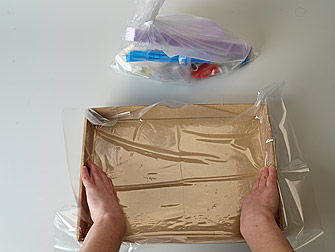
  • Create with the top of the box, a laboratory basin. Take the plastic bag to protect the rest of the material.

  • Lay a plastic film inside the cardboard box and flatten it out.
 
Labor1b
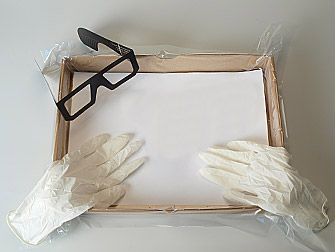
  • Cover the bottom of the box with a white sheet.
  • Lay the glasses and gloves within easy reach.
Labor3 Prepare the solution
  • Put the glasses and gloves on.
  • Open the copper sulphate and citric acid container in the basin.
Galvanisation
 
  • Fill three quarters of the container with water (yellow arrow).
  • Screw the lid on and shake the container to dissolve the powder.
 
Galvanisation
  • Unfold the wire downwards (green arrow)
6_Galvanisation
  • Place the clip like shown on the picture. The bended part dips in the water!
  • The sulphate solution has now a blurry and bluish aspect.
galvanisation
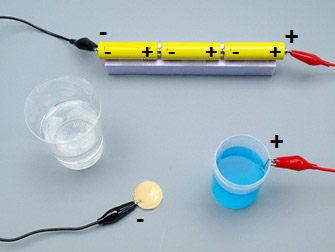
Assemble the 4.5 Volt tension source

  • For the copper galvanization, we need a 4.5 Volt tension source. But we only have 1.5 Volt batteries. How can we do it? Who finds a solution?
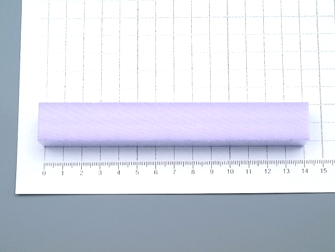
  • Cut a 14 cm piece out of the foam stick.
Galvanisation
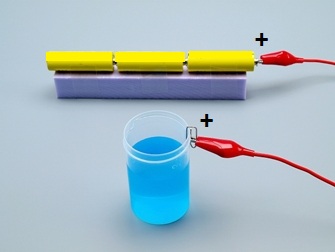
  • Link the batteries with two ring magnets. Put two other magnets on the free poles (green arrow).
  • Careful: The positive pole (+) must always be in contact with the negative pole (-) of the beside battery. (series circuit)
  • Fix the batteries to the foam with tape.
galvanisation Prepare the galvanization
  • Connect the positive pole (+) of the tension source to the clip in the container.
Galvanisation Make sure the plier holds on the clip well!
Galvanisation Careful: The plier on the other side of the wire must well be in contact with the positive pole magnet (+).
galvanisation_b


explore-it 
Galvanisation

  • Connect the metal plate to the negative pole (-) of the tension source.
galvanisationb
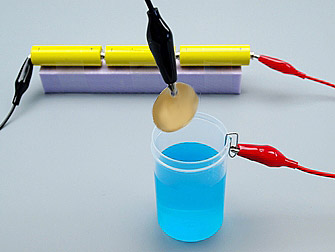
  • Completely dip the metal plate in the blue copper solution.


  • As soon as the plate is in the solution, bubbles appear around the clip...


Galvanisation
  • Careful!
  • The plate mustn't touch the clip.
  • The plate must constantly be in movement and the solution stirred.
18_Galvanisation
  • Check now and then the colour change of the plate.
19_Galvanisation
  • Take the plate out after one minute, rinse it with water and dry it.


Who is explore-it

gemeinnütziger Vereina charitable association
The service agreements with the supporters of explore-it stipulate beginning with the project status that explore-it will become a provider of teaching and learning materials. It was not possible to provide materials and services for sale, being a research and development project of the Schools of Education. For this reason, the association was founded in cooperation with the partners of explore-it. The goal of the association is the promotion of technical understanding and natural sciences for children and youth. The association is exclusively non-profit and is tax-free since February 2010. The explore-it materials are assembled at the ARWO (sheltered workshop for persons with disabilities) in Wettingen in Argovia, Switzerland.
 
StiftungFoundation
To obtain advantage of donor funds and using them for specified purpose, the association created in august 2012 the "explore-it foundation". The aim is to promote understanding and innovation of children and adolescents in science and technology and to support and fund activities of the explore-it association.

Forschungs- und Entwicklungsprojekta research and development project
explore-it goes back to a spin-off of the University of Teacher Education Valais (PHVS) and the PH of the University of Applied Sciences Northwestern Switzerland (PH FHNW) from 2008.

pdfDownload Flyer

My Account

Sequences: Guide
You have access to the task descriptions and experiments as soon as you receive the kit.

Newsletter

You will receive important information regarding explore-it four times yearly with this registration.